How to work with a nail drill to make it your partner for years
5 most common nail drill operating mistakes: crooked bits (microvibrations), too deep insertion, handpiece falls, no dust extraction, improper grip. Practical tips straight from a nail salon.
Introduction
The nail drill is an important desk partner in a nail stylist’s work - reliable, precise and always ready for action. Like any everyday tool, it also requires an appropriate approach and care. So it’s worth knowing what affects its lifespan in practice and how small habits during work can determine how long it will serve us without problems.
In daily work, it’s easy to get used to certain movements or ways of working with the nail drill. Seemingly nothing threatening - until something starts to “happen”. Sometimes it’s little things that can gradually affect the device’s operation and precision over a longer period. What we point out below results directly from our salon experience - we’ve been running a nail salon with several stylists for years. We complement this experience with knowledge from the store, where we’ve already sold hundreds of devices and observe what problems users encounter most often.
1. Crooked, worn bits
- bits after a fall, decalibrated, low quality from an unreliable source cause microvibrations
- the vibrations can be imperceptible, but the drill “feels” them always
- result? Rapid destruction of bearings - even within a few weeks
It often turns out that among the set of tools there are several bits that, on closer inspection, turn out to be crooked. Importantly - such a bit doesn’t always make itself known at every speed. At low speed it can work completely stably, while at higher revolutions it begins to cause vibrations that strain the drill mechanism. If we mainly work at lower speeds, it’s easy to overlook the problem and think everything is fine.
Let’s use an example from practice: one of our clients, on our suggestion, thoroughly reviewed all her bits - a dozen, or maybe even several dozen pieces. It turned out that three or four of them were crooked, and what’s worse - she was using those most often. As a result, the lifespan of her drill significantly shortened, even though everything seemingly looked correct.
Using an automotive example: in cars, the wheels are balanced so that there’s no wobble effect and the bearings don’t get damaged.
For comparison
At a speed of 100 km/h, a typical passenger car’s wheels make just under a thousand revolutions per minute. Meanwhile, the bit in a drill works even 35 times faster. This shows how enormous forces act on its bearings and how important the correct insertion and quality of the bits used are.
2. Bit insertion and matching speed to diameter
- too deep insertion of the shank or inaccurate seating
- too much pressure instead of work in line with the principle: high rotational speed = low pressure force
- the above factors can cause bit deformation, head overload and faster bearing wear
- if the bit shank diameter is larger than provided by the drill manufacturer, the head doesn’t close properly, which leads to additional play and loads
It’s important that bits are matched to the device - meeting the requirements specified by the drill manufacturer. A bit is not only the working tip, it’s also the shank, and it can be different. There are specific standards (e.g. for the SNG drill: ISO 7785-2 Type 2), which specify the dimensions and tolerances of shanks (i.e. the part of the bit that is inserted into the drill head). The differences may seem small, but in practice have great importance for work stability and safety. E.g. too large a shank diameter contributes to non-closing of the drill collet, and working in such a state damages the bearings.
For cosmetic drills, shanks compliant with the following dimensions are most commonly used:
- 2.35 mm (3/32 inch) - the most popular standard, specified precisely by ISO 7785-2 Type 2
The depth of bit insertion is also important. It’s recommended that the shank is inserted into the collet to a depth of 27-30 mm. The greater the part of the bit remains exposed, the more strongly the centrifugal force acts on it - and this increases the risk of shank deformation. In practice it means that if the bit is too far extended, working at high revolutions and pressed simultaneously with high force, over time it can simply bend slightly.
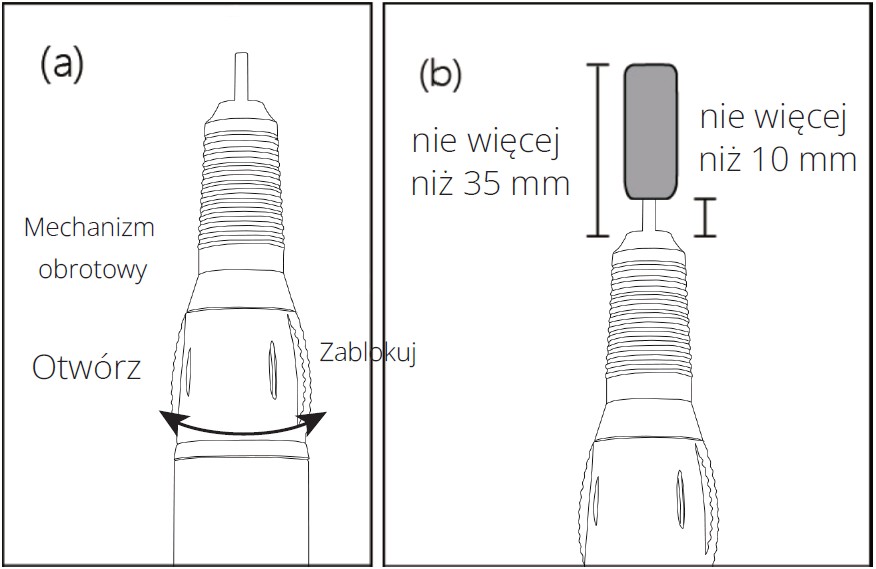
Source: SNG drill user manual (Gurgul Investment sp. z o.o.)
Such deformation not only strains the bearings, but can also lead to deformation of the collet itself in the head. So it’s worth paying attention to the bit being seated stably, but not by force, and that its length and rotational speed are matched to the manufacturer’s recommendations. With large tips or bits of greater diameter, special caution is required - too high speed and pressure can not only shorten the drill’s lifespan but also create unnecessary risk of tool damage.
For the SNG drill, we present a practical table below in which we provide suggested rotational speeds for various types of bits.
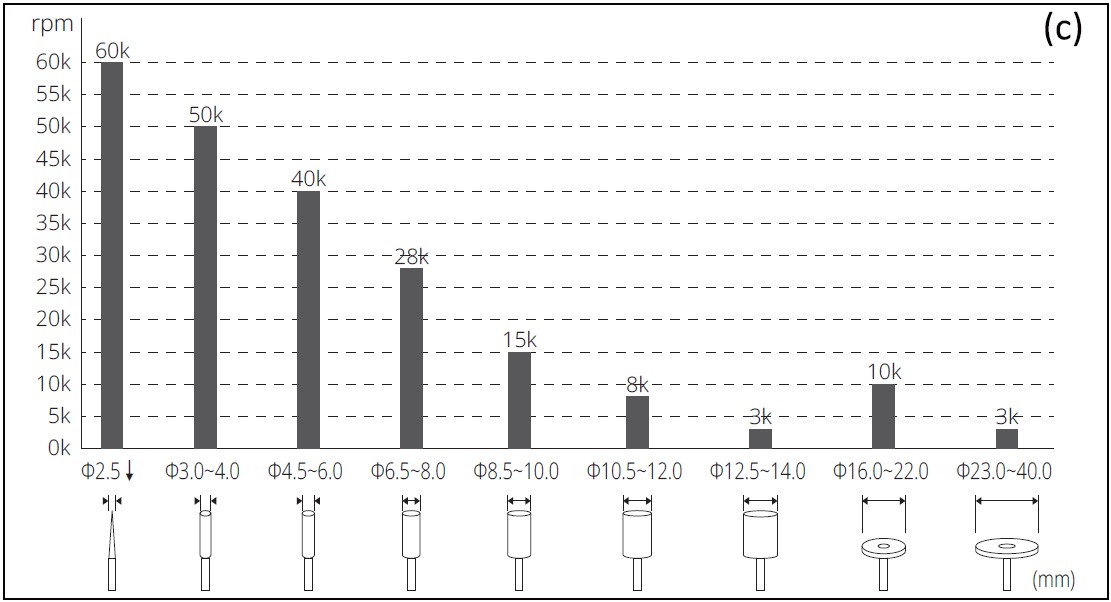
Source: SNG drill user manual (Gurgul Investment sp. z o.o.)
3. Handpiece and bit falls
- even a slight fall of the drill handpiece or bits can lead to slight axis misalignment
- at high revolutions this manifests as wobble that sometimes the stylist won’t feel, but the drill already does
- it’s another factor accelerating bearing failure
4. No dust extraction and drill cleaning
- the dust created during nail work is sucked in by the drill
- accumulates in the head
- combined with moisture, forms a hard deposit that may prevent proper closing of the head - and as we know, an open head and high speed damage the bearings
- effect: greater strain on the mechanism and faster destruction of bearings
5. Improper grip of the drill
- some stylists have a habit during work of slightly twisting the handpiece, which causes slight opening of the head
- in the short term it’s not visible, but with long-term work such a habit causes faster bearing wear
How to extend the drill’s life?
- use bits from proven sources, matched to your device
- regularly check the condition of bits - after a fall, it’s best to eliminate them immediately
- seat the bit in the head correctly - not all the way “by force”
- work lightly - high rotational speed requires less pressure
- maintain hygiene - use a dust absorber
- avoid falls of the handpiece and accessories
Summary
A nail drill is an investment for years - but only if you take care of it consciously. In most cases, rapid bearing wear doesn’t result from device defects, but from small operating errors. And a little attention is enough for your drill to work quietly, stably and reliably for many seasons.